Coming Clean ….

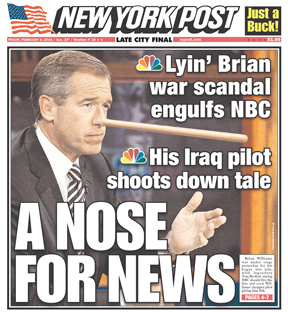
Poor Brian Williams has really put his foot into it. In fact, the NBC anchor has sunk up to his knees. But these sort of pesky memory slips can happen to just about anybody, can’t they?

In that spirit, I’ve decided to clarify some of my own past comments: NYPost Williams

I was not aboard the HMS Titanic when it sank in 1912. It turns out that I was on a ship that crossed the Atlantic 61 years later that passed through the general vicinity where Titanic struck the iceberg. (Though in my case it was July and not April, and I was a 7-year old boy traveling with my parents, and not, as I initially stated, a 19-year old Irish colleen emigrating to America, lured by the promise of a job as a washerwoman in the South End of Boston and engaged to marry a man she had never met.)

Somehow my memory “conflated” these two not-even-remotely connected events and I apologize if I somehow unintentionally, inadvertently, or unconsciously mislead anybody. It’s amazing the tricks the mind plays on you sometimes!

Also, while I’m at it, I’d also like to clear the air and also state that I was not a witness to Pickett’s Charge at the Battle of Gettysburg in 1863. It turns out I was in Philadelphia during the summer of 1981….


Leave a comment

Filed under Uncategorized

Praising Hope

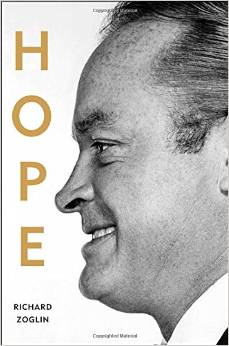
I don’t usually read celebrity biographies, but I made an exception for Richard Zoglin’s recently published life of Bob Hope, which attempts (successfully, I think)  to restore some shine to the comedian’s star, which had dimmed  considerably years before his death in 2001 at age 100.

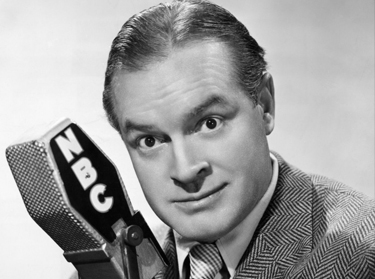
UnknownZoglin makes a strong case for Hope as arguably the most important entertainer of 20th century America. Indeed, it’s hard to comprehend the extent to which Hope utterly dominated popular media and entertainment at the height of his career, which stretched from the late-30s through the mid-60s. At his peak, he was seemingly ubiquitous.  Long before anyone had ever conceived of “multi-platform distribution,” Hope had the most popular show on radio, and was No. 1 box office draw in Hollywood, appearing in a steady stream of hit movies. Moving his act to television in the early 50s, his shows regularly drew ratings that modern TV executives, operating in an era of declining audiences and fragmented media markets, can only fantasize about; almost half the TV homes in the country tuned into to the broadcast of Hope’s 1969 Christmas tour of Vietnam, for example.

In between, Hope hosted the Academy Awards a record 19-times. There were also his syndicated newspaper columns, books, commercial endorsements, promotional appearances, a parade of charity benefits, even comic books. Plus, of course, his annual Christmas tours to entertain US troops serving overseas, which began in 1943 during World War II and continued for more than 40 years, including the Korean and Vietnam wars.  (His persistent, vocal, and reflexive support of the Vietnam war was a sign that by the late 60s, Hope was losing touch with audiences.) More than a mere entertainer, Hope transformed himself into a national brand and not-so-small industry.

Hope practically invented modern stand-up comedy and the art of the comic topical monologue on his radio shows of the 1940s, according to Zoglin, unleashing a torrent of one-liners in his brash, rat-tat-tat delivery, making fun of  Roosevelt, Republicans, the New Deal, Hitler, and the events of the day in equal measure. Although he started in vaudeville, when he moved to radio Hope realized that the new media required an endless supply of new material to keep the audience coming back; he was the first comedian to hire his own staff of writers to create an on-call joke factory to back him up (a model widely copied since). Without Hope — the ur-standup — there would be no Carson, Allen (neither  Steve nor Woody), Pryor, Leno, Letterman, Seinfeld, or Fallon or any one else.

Another of Hope’s innovation: He was the first Hollywood actor to create his own production company as a way of Hope with micseizing more control over his films, and also squeeze more money out of the studios. Driven by his insatiable dealmaking, by the early 80s, Hope was widely reported to be the richest entertainer in Hollywood, with a net worth estimated as high as $200 million. For all that, he was also intractably cheap. Writers summoned to his home for Sunday morning  show conferences were routinely told to “bring your own orange juice.”

At his best, Hope was very funny, his timing and delivery unbeatable. I remember my mother laughing helplessly at Hope’s introduction to the 1968 Oscars: “Welcome to the Academy Awards. Or as it’s known in my house, Passover.” And his comic turns in his best movies, such as some of his “Road” movies with Bing Crosby, are light and deft and have lost none of their power to amuse even 70 years after they were filmed. But for all that, Hope’s humor is curiously impersonal and detached. The audience never gets a glimpse of the guy behind the avalanche of wisecracks; in all of his movie work, there is little that is personally revealing, nothing that comes close to, say, “Annie Hall.”

One’s left with the strong  impression that there really wasn’t much to know. Focused exclusively on his work, Hope never read books. As a result of his decades of  incessant touring and performing, The Guiness Book of Records called him the human being seen by more people in history, but Hope himself was a semi-stranger to his own family, popping in between months-long tours. He was also an Olympic-class philanderer and skirt chaser, his countless and flagrant extra-marital romps winked in industry circles and ignored by the era’s more protective press. (This last bit is the only bit of Hollywood gossip I can personally attest to. Dining with friends at a Pasadena restaurant in 1988, we saw Hope, then in his mid-80s, at nearby table with a well-turned out blonde woman half his age. He was presenting her with an expensive piece of  jewelry and it was clearly a date.)

By its nature, topical humor has a short, short shelf-life — there’s nothing deader than yesterday’s headlines except the jokes that spun off them. That might be one reason why Bob Hope is so little recalled nowadays. Certainly, his refusal to gracefully retire  — even in his 90s, as he was clearly failing, he insisted on taking the mic — did nothing to burnish his legacy. But in his prime, he was something, and Hope deserves better.


Leave a comment

Filed under Uncategorized

A Really Smart Idea That Will Probably Go Nowhere

A rare picture of the F-35 in flight

A rare picture of the F-35 in flight

Of all the proposals that Obama unveiled in last week’s State of the Union, the one that immediately caught my attention was his proposal to make the first two years of community college free for everyone. That struck me as smart thinking and cost-effective policy — experience has proved that investing in education always pays off in greater economic growth, boosting national competitiveness, higher wages, etc. And the president’s proposal could be achieved for only $60 billion over a decade, peanuts by Washington standards. (For you former English majors out there, that’s $6B a year.)

Of course, Republicans rejected Obama’s proposals out of hand, writing them off as more examples of his runaway tax-and-spend liberalism, even as they called out Obama for ignoring education. Sen. Lamar Alexander seemed to be particularly mired in the GOP reality-denial field and reflexive Obama bashing: “I would think the president in his last two years would actually want to accomplish something. And if he focused on trade and education; cybersecurity; fixing ‘No Child Left Behind,” and making it easier to go to college [emphasis added], all those are areas where we can get some agreement,” he told the Times. Huh? Perhaps the distinguished gentleman from Tennessee  was listening to a different speech than the rest of us

To put that $6 billion annually for community college in perspective, the U.S. currently spends about $23 billion a year on various agricultural subsidies, the vast majority of which ends up supporting large industrial farms and agribusiness.

And that projected $60 billion outlay over a decade is milk money compared to the $400 billion the Pentagon will spend in coming years to acquire 2,400 copies of the F-35 Lighting II (A.K.A. “Fighting Turkey”) stealth jet-fighter, which a Rand Study concluded “can’t turn, can’t climb, can’t run” and has been grounded no less than 13 times since 2007 because of persistent engine problems. The trouble-plagued F-35 is widely referred to as the most expensive single weapons program in history. Depending upon the service variant, the price of the F-35 ranges from $150 million to more than $225 million per plane; that is merely the production cost, furthermore, and does not include the money spent on research and development and testing, or the cost of actually operating, maintaining and upgrading the aircraft once it enters service, which is projected to be $1.5 trillion during the F-35’s lifetime.

In the long-run, which program do you think will ensure America’s future security and prosperity: Putting more people in college classrooms, or acquiring a fleet of hyper-expensive “hanger-queens?”  The answer to me is clear.

Leave a comment

Filed under Uncategorized

Stories Too Good to be True

rtl141215_islam_560I would love to know what went through the minds of New York editors when Jessica Pressler first handed in her now discredited story of the high school-senior Master of the Universe, who falsely claimed to have run up an eight-figure fortune trading stocks during his lunch period. It’s not entirely surprising the kid managed to dupe one reporter, but where were the older, wiser and more skeptical eyes that were supposed to keep her on track? Why didn’t they sniff the pungent odor of bullshit?

Just for the record, when I read the story I instinctively called it Sketchy in the First Degree: to amass $72 million in three years would require a stupendous rate of return. Someone at the NY Observer had the presence of mind to pull out a calculator and figured that Mohammed Islam’s purported annual rate of return was on the order of 800 percent, assuming he started in 9th grade with $100K to invest. Such exospheric returns, if even possible, would make George Soros look like the Beardstown Ladies.

So, what happened? Obviously, sloppiness and carelessness played a big role, but I believe that the magazine’s editors were also blinded by the Facebook Effect. They had read too many stories of young male techno-wizards who have amassed huge wealth within the span of only a few years on the back of some killer app or another (viz, Instagram, Snap-Chat, Uber, Airbnb, Dropbox), often while they’re still immature enough to require a  parental  signature to rent a car. The business press is awash in get-richer-than-Croesus tales; we no longer think there’s anything odd about a twenty-something college drop-out with personal wealth valued in the hundreds of millions. Taking a lifetime to accumulate your first $100 million is so 19th century; John D. Rockefeller has been surpassed by Sean Parker and his ilk.

And if a 30-year old like Zuckerberg can be worth $32 billion, then why can’t a 17-year old like Islam rack up a measly $72 million trading penny stocks? The fact that his numbers seemed suspect was ignored because the story somehow aligned with the new paradigm of vast wealth created  virtually overnight, all without breaking a sweat.

Leave a comment

Filed under Uncategorized

An Open Letter to Mark Zuckerberg

Dear Mr. Zuckerberg:

Yesterday was certainly a big day! Congratulations! Your first IPO! Wowza! You’ve worked really hard the past eight years on Facebook, writing and perfecting code, forging alliances, courting investors, and burning the midnight oil who-knows-how-many nights, to make sure it was a success. You also had to put up with those annoyingly persistent, perpetually entitled Winklevosses and their ridiculous legal challenges. Now it’s finally time to harvest the fruit of all that hard work. Congratulations once again.

But as you start count your billions — according to the Wall Street Journal, your stake in FB could be worth as much as $28 billion (my, that’s a lot of fruit!) — I’d like to remind you wouldn’t have bupkis without the 845 million FB users who have been pumping it up with free content for years now. Not to mention all the reams of highly valuable personal data we’ve handed over your servers without complaint, which you in turn peddle to advertisers at a nice premium.

Nothing wrong with that, I guess, it’s the Way of the Web, right?

So, if you want to show a little gratitude to the faceless FB hordes who have helped enrich you, how about spreading a little of the wealth around, Mark? (Do you mind if I call you Mark? It’s my name too!) You could give each of your  hundreds of millions of  users a small amount, a tiny token of personal appreciation, for making you a multi-multi-billionaire before you’ve even turned 30, while most of your former Harvard classmates are still struggling to pay off their college loans. You could pay them—say, 10 bucks a head?—and still have $20 billion left over for yourself.  You’d barely miss that $8 billion, but think of the good will it would buy! And the publicity! You’d still have enough left for a big house in the Palo Alto and a garage full of Maseratis, if that’s your thing (which I don’t think it is). You’d be sharing your wealth, just like Oprah does with her studio audience, but on a much vaster global scale. They’d probably write you up in People magazine.  Think of it as pioneering a new form of peer-to-peer micro-philanthropy.

Anyway, it’s something to consider. If you want to send me my $10 via PayPal, I’ll forward you my email. Wait a minute, you know that already. Silly me.

What is it that you kids say?

“Just sayin’.”

1 Comment

Filed under Uncategorized

A Few Minutes Thinking About Andy Rooney

I can’t say I was a great fan of Andy Rooney on 60 Minutes, but I admired his longevity and work ethic. Older people (one of which I hope to be, some day) are practically invisible on TV, and when they are shown they are almost always depicted as either doddering fools or sweet, harmless retirees, with nothing to contribute. Rooney was a exception to this rule and however cantankerous he might have been, he rightly insisted he still had something to say and it was worth listening to. Working in a media (and society) increasingly obsessed and focused on youth, he was a reminder that youth is inevitably fleeting and dissipates, while experience accumulates and compounds itself throughout life. If you’re lucky to live long enough, that is. And reaching 92, Andy Rooney was.

Leave a comment

Filed under Uncategorized

A Week (Almost) Off the Grid

On Saturday, March 13, 2010, the day of the Great Nor’easter, I was sitting on the couch at home when the power flickered out.  The wind had been howling for hours, the gusts growing so furious in duration and power that I found myself holding my breath until they subsided, only to repeat the unsettling cycle a few minutes later. It felt the world was going to blow away, Oz-like, into another dimension.  Then, just before 3 p.m., just after a particularly vicious gust shook the house, the television and house lights blinked twice and died.

“This might be a long outage,” I thought to myself. Turns out, I didn’t know the half of it.

After a spell (actually a short nap — what else do you do when the cable goes out?) my wife and I rustled in the cupboards and pulled out all the candles we could find, as well as the electric lantern stored in the basement, and cooked dinner by their soft glow.  Fortunately, we have gas range, and while the electronic ignition was now useless, we had plenty of kitchen matches to light the stove burners.  We ate dinner—pasta mama—by candlelight and listened to the incessant wailing and whooping of emergency vehicles all around us, their sirens managing to briefly down out above the incessant shrieking of the wind.

The TV was dark. The stereo was mute. The internet was down. We listened to accounts of the storm’s fury over a battery-powered  radio that my wife Susan had acquired in one of her frequent bouts of preparation for the Apocalypse. (Suddenly, her disaster-philia didn’t seem quite so silly.)  The radio reported that at least five people in the metro New York area had been killed by falling trees since the nor’easter began. We called our teenaged son and told him to spend the night at the friend’s house where he had gone earlier that day—walking home or driving even a few blocks was out of the question.

Around 8:30 p.m. the storm was at its height;  later we learned that gusts had been clocked at over 60 mph. I took the dogs  downs to the garage and opened the door in the hope they would dart out into driveway  and relieve themselves. They refused to budge and looked at me as if I were speaking to them in Esperanto.  We watched a towering 65-foot pine tree in my neighbor’s yard swing back-and-fourth like a giant metronome, keeping time with the wind’s fury.

We retreated inside and pulled out the Monopoly board.  My teenaged daughter may not be able to keep her room clean for love or money, but on the Monopoly board she managed to clean me out in short order.

The next morning everything was still. I went outside to see what souvenirs the storm had left.  We were lucky: none of our trees were damaged. Our neighbor was not so fortunate. The towering pine that the night before I had watched oscillate madly now leaned at a 35-degree angle, as if exhausted by its ordeal.

Up the street, all was mayhem. Three huge, mature pines had toppled willy-nilly across the road, pulling down telephone poles and snapping electrical lines like worn shoelaces. The street was littered with branches and wires. Another tree had smashed a sturdy stone wall as if it were clay. The roads were impassable.  A little further up the hill, the road was covered with a ragged carpet of shingles—the storm has sheared them off a nearby house.

Cleaning up this mess would take days. The power wouldn’t be coming back on anytime soon.

Fortunately, the weather forecast predicted mild temperatures in 50s for the next few days, so the house wouldn’t cool off too quickly.  And thanks to our gas hot-water heater, we still had hot water, so we could wash dishes and shower. So while many of our neighbors hightailed it for the nearest hotel/motel until power was restored, we decided to stay tough it out at home.

With no juice, no TV, no cable, no DVD, no computers, no radio (save our tinny emergency transistor), the house was quieter and felt calmer than it had been in years. Without no electricity, over the next five days our daily routines changed completely.

We focused inward, upon the family and upon ourselves. Instead of sitting down to check my email as I drank my first cup of coffee, I built a fire in the living room to take off the chill and then sat down to a leisurely breakfast with Susan. With many roads still impassable, she could not get to work, providing us both with time to read the Times from the top of the masthead to the bottom of the sports page agate. (Yes, believe it or not, after the first day the newspaper carrier somehow got through to deliver the aptly named dead-trees version.) My son no loner fused himself immediately upon waking up to the screen of his computer. We actually talked — mainly, it’s true, about when the power was likely to be turned back on so he could get back to his games — but hey, we did talk. No longer mesmerized by her friends’ doings on Facebook, my daughter discovered the face-to-face pleasures of playing board games.

Time. Slowed. Down. Not necessarily a bad thing. And simultaneously, over those quiet days our house became an utterly private space, belonging only to us — without electricity, the larger world stopped short at the threshold. And though I never entirely banished the incessant urge to go check the internet just for a second, a good part of me enjoyed doing without it for a few days. It felt like an enforced — but no less appreciated — vacation.

The late Daniel Boorstein, the unusually insightful historian of quotidian life on Main Street in his trilogy The Americans and a perceptive media observer, wrote that the 20th Century’s proliferation of mass media — radio, movies, TV — caused its distracted and besotted audiences to “drown in the instant present.”

The situation has gotten worse since the Internet. Nowadays it often feels as if we’re being swept away by a tsunami of digitized information.

I not saying I wasn’t glad to see the convoy of Con-Ed bucket trucks drive up our street on the fifth day of the power outage, knowing that we’d soon be reconnected to the grid. Nor do I want to go back to living by gas-light and cooking with over a wood stove. Hell, I was glad to get the TV back, too.

But those five days without electricity (and all the conveniences it delivers) were rejuvenating, a respite from the torrent of information one normally feels compelled to try to keep up with. It felt like coming up for air.
2 Comments

Filed under Uncategorized

Here’s a Scary, Mind-blowing Statistic

Yes, we’ve known for a long time that the real-estate crash/foreclosure crisis is really bad. But just how bad is it? According to today’s Wall Street Journal, “Nearly eight million households, or 15% of those with mortgages, are behind on their payments or in the foreclosure process.”

Yikes!

Leave a comment

Filed under Uncategorized

Meanwhile, Back in the “Real” World…

I have a terrible, hard-to-shake suspicion that “Vienna” is going to be the second-most popular girl’s name in the country in about three years.

(Sigh.)

Am I the only one who believes that the real intent of reality TV is to provide a privately run economic stimulus program for third-generation trailer-park residents? Convince me I’m wrong.

Leave a comment

Filed under Uncategorized

Mogadishu on the Hudson

Few politicians have managed to waste the considerable political capital they inherited upon taking office as hastily as our profligate and erratic Gov. David Paterson, who was the beneficiary of so much good will when he suddenly took over from Client No. 9 only two years ago.  In that time, he’s gone from hero to zero.  And since the story broke of his latest mind-twisting political and legal blunder, I’ve been trying to think of an appropriate Third World nation to compare to the dysfunctional political culture and leadership afflicting those of us who still choose to reside in New York.

More and more these days, residents of New York feel powerless and disenfranchised, standing by helplessly as our political leaders pettily scheme against each other, line their own nests, and grandstand in the media—anything but effectively address the mounting fiscal problems that overhang the state  like Damocles’ sword.  Paterson’s self-inflicted travails have made great political theater, but they should deeply depress anyone who has a stake in New York’s future.

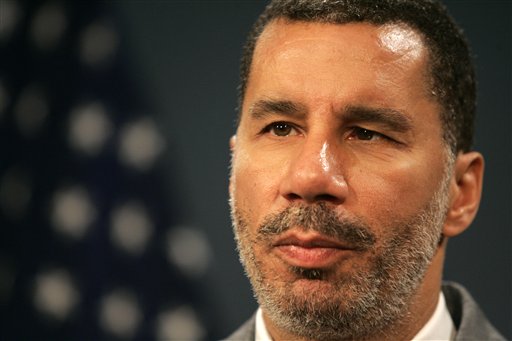
The Governor, for now

Increasingly, the once-glorious Empire State is beginning to resemble Somalia (No. 1 on the Fund for Peace’s Failed State Index).  A failed state, according to Wikipedia, is characterized by “[a] central government is so weak or ineffective that it has little practical control over much of its territory; non-provision of public services; widespread corruption and criminality … [and] sharp economic decline.”

As a New York resident since 1989, all I can say is that certainly sounds familiar.

This would make Albany the equivalent of Mogadishu. The only significant difference being that there’s probably more exciting things to do on a Friday night in Mogadishu.

Update 3/2/2010: The stench surrounding Paterson grows worse, as The Times reported Tuesday that the governor personally ordered two of his aides to contact the woman allegedly physically abused by his top aide. A political deathwatch has commenced: Top Democratic Party officials are said to traveling to Albany to meet with Paterson and discuss his options, as calls for his resignation grow.

If the New York were to lose its second governor  in only two years, it would be a horrific blow to the state’s image and future.  Me, I take absolutely no joy in any of this.  And while I’m usually among the last people to believe anything I read in The New York Post, a recent insider account of Paterson’s behavior in office—admittedly based on interviews with anonymous former aides—has the whiff of truth.  The most damning material was buried at the end, depicting a politician without any understanding of  the political process:

During talks about industrial-development policy, the governor slipped an overhaul proposal to some labor groups — then went to business big shots and loudly bashed all the suggestions that had come from his own office, said a source involved with the process.

“He was trying to determine what was his political advantage at any given moment,” the source said.

Paterson’s zaniness torpedoed a high-profile bill extending unemployment insurance last summer, sources said. After intense talks with labor and business leaders, the governor hammered out legislation both sides could live with.

“Then he sent out his own program bill without discussing it with anyone — and of course it was acceptable to no one,” said a lobbyist. “It just shows a complete lack of understanding of how the process works.”

That would certainly explain some otherwise inexplicable gubernatorial episodes, such as his mercurial, ill-treatment of Caroline Kennedy’s senatorial ambitions.

I hazard the guess that Eliot Spitzer is sleeping very soundly these nights.

Update 3/3/2010: It’s getting worse and worse, as the slow drip of revelations about gubernatorial misconduct now looks like it’s becoming a stream.  Anybody care to lay even money that David Paterson will still be in the Governor’s Mansion come May 1? While that would have been unthinkable a few days ago, it’s not so much today.

Leave a comment

Filed under Uncategorized